
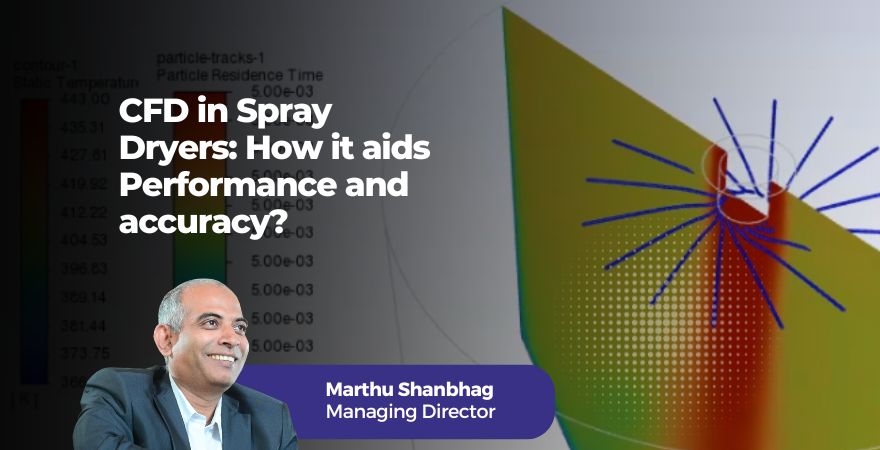
Spray drying works best when airflow, droplet formation, residence time, and capture are aligned to the product spec. Computational Fluid Dynamics (CFD) lets engineers test and tune these variables before fabrication or commissioning, cutting guesswork and reducing trial iterations.
Chamber Airflow: Designing the Drying Path
CFD first clarifies chamber airflow. By mapping how hot air enters, mixes, and moves through the chamber, it reveals velocity fields, temperature gradients, and recirculation zones. Designers then adjust inlet geometry and angles to avoid dead zones, set residence time so droplets dry within the intended window, and smooth flow near surfaces to reduce wall deposition.
Particle Behavior: Linking Air to D50/D90
It also links particle–air interaction to particle-size distribution (PSD). Particle tracking shows droplet trajectories and evaporation paths, tying airflow to D50/D90 and final moisture. With volumetric distribution across the chamber, engineers can anticipate where coarse or fine fractions migrate and identify zones prone to agglomeration or fines carryover.
Atomization Settings: From Spec to Droplet Band
On atomization, CFD moves decisions from trial-and-error to spec-driven settings. For pressure nozzles, it relates pressure and orifice selection to target micron bands. For rotary atomizers, it helps tune wheel diameter and speed (escape velocity) to set initial droplet size and spread. The result is an initial droplet band that sits close to the requested PSD before the first run.
Cyclone Efficiency and Stable Start-ups
Capture improves as well when cyclones are modeled. Refining inlet orientation, body proportions, cone angles, and pressure-drop trade-offs raises mechanical efficiency and reduces fines to the exhaust, improving yield and keeping stacks cleaner.
CFD also smooths scale-up. It provides a bridge between pilot and plant by normalizing for changes in air temperature, humidity, and load. Sensitivity checks flag small shifts in flow or temperature that can degrade PSD, and the model produces practical set-point bands for airflow, temperatures, and atomization that guide commissioning.
Utilizing CFD to get best results
Good inputs make CFD useful. Target PSD (D50/D90), moisture, and bulk density must be paired with feed properties such as solids percentage, viscosity, surface tension, and solvents. Thermal limits (inlet/outlet air temperatures, heat balance) and hardware constraints (chamber size, available pressure/flow, filter or cyclone limits) round out a model that mirrors reality closely enough to drive decisions.
In practice, teams see tighter PSD on early batches, steadier operation windows across seasons and shifts, lower wall build-up, higher cyclone capture, and fewer start-up iterations. The bottom line is that CFD turns spray dryer design from “test and tweak” into a data-led process.
The Shachi Way
Shachi has applied CFD to spray drying for the last eight years, helping plants achieve the specified particle sizes, cleanliness, and capture targets with greater confidence and predictability.