


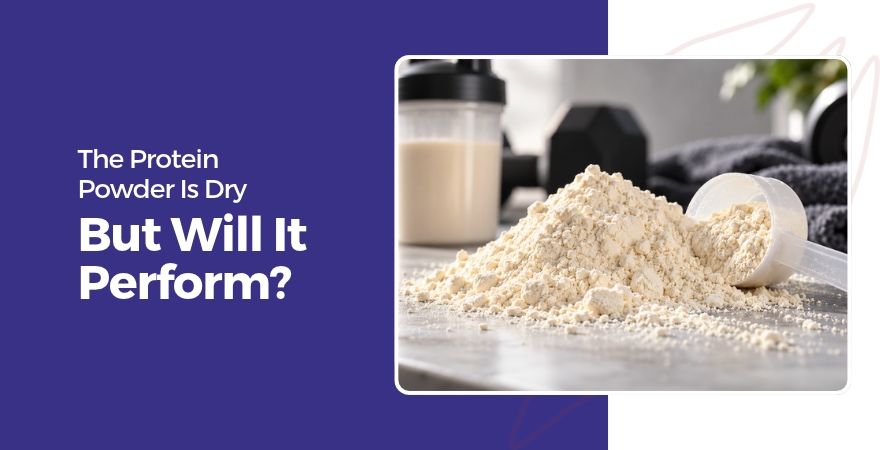
A batch of protein powder leaves the spray dryer. The moisture level is within specification. Production looks satisfactory.
But when the powder reaches the next stage, a different problem appears.
It takes longer to mix. Some particles form lumps. The powder does not flow as expected.
The drying is complete. But is the powder ready for its intended application?
This is an important question for manufacturers of whey proteins, milk protein concentrates, plant proteins and nutritional powders.
Meeting the Moisture Target Is Only Half the Job
Proteins need careful handling during drying.
Excessive thermal exposure can affect protein structure and functionality. Depending on the product, this may influence solubility, colour, flavour and other important characteristics.
At the same time, manufacturers must remove sufficient moisture to achieve the required powder stability.
A conventional single-stage spray dryer can work well for many applications. But some protein products need closer control over final drying and powder conditioning.
The challenge is to achieve the required moisture without compromising the properties that make the protein valuable.
Why Make One Drying Stage Do Everything?
A Multi-Stage Spray Dryer distributes the drying process across different stages.
The spray drying chamber first removes most of the moisture. The partially dried particles then enter an integrated fluidised bed, where the remaining moisture can be removed under controlled conditions.
Final cooling and powder conditioning can follow before discharge.
This arrangement gives the process engineer greater flexibility. The initial drying stage focuses on rapid moisture removal. The fluidised bed provides additional control over the final powder condition.
The objective is not simply to dry more. It is to dry correctly at every stage.
Better Mixing Begins with Better Particle Formation
For many protein powders, performance in water is an important quality requirement.
Fine particles may be difficult to wet or handle. Depending on the formulation, controlled agglomeration can help create larger, more porous particles that wet and disperse more readily.
An Integrated Fluidised Bed Spray Dryer can be configured to support this process.
However, agglomeration alone does not guarantee complete protein solubility. Feed composition, protein functionality and drying conditions also matter.
The right process must be selected around the powder specification.
The experience matters just as much as the performance
A well processed protein powder should mix smoothly and deliver a pleasant mouthfeel without unwanted stickiness or a gritty texture. Achieving the right particle characteristics through controlled spray drying can contribute to a smoother, more enjoyable drinking experience.
Different Proteins Bring Different Challenges
Whey Protein Concentrate (WPC), Whey Protein Isolate (WPI), milk proteins and plant-based proteins do not behave alike.
Dairy proteins may require close attention to thermal exposure and reconstitution properties. Pea, soy and other plant proteins can present different feed viscosities, water-binding characteristics and powder-handling requirements.
Newer protein sources, including fermentation-derived proteins, may introduce further variations in feed behaviour.
This is why one set of operating conditions cannot be assumed suitable for every protein application.
The Real Efficiency Is Seen During Production
For plant managers, powder quality is only one part of the equation.
Energy consumption, product recovery, wall deposition, cleaning frequency and plant availability also influence operating cost.
Multi-stage drying can provide opportunities to improve thermal efficiency and reduce unnecessary stress during final moisture removal. But the actual benefit depends on the product, operating conditions and plant design.
The goal is consistent saleable output with dependable operation.
Start with the Protein. Engineer the Process.
At Shachi Engineering, we believe the right drying system begins with understanding the product and its final application.
Feed properties, heat sensitivity, moisture requirements, particle characteristics and downstream handling must be considered together.
Our Integrated Fluidised Bed Spray Dryer combines primary spray drying with controlled final drying, cooling and powder conditioning.
Because for protein manufacturers, success is not simply getting the water out.
It is getting the right powder out. Consistently.
Planning a protein powder manufacturing plant?
Speak to No. 1 Partner – Shachi. Let us discuss the right Multi-Stage Drying System for your application.